Hope Jennings
  • Home
  • Publications
    • Nostalgia
  • Teaching
  • Blogs
    • Women's Writing
    • British Literature
  • Contact

Swinburne’s Hymn to “Other” Sexualities

5/18/2020

1 Comment

 
Picture
I’m mainly going to focus on Swinburne here, since his work can be quite challenging for students. The Swinburne poems that we read this week also help highlight some of what we will encounter in the modernist period. For instance, like many modernist poets, Swinburne’s allusions to Greek mythology might be read as a rejection of Victorian/Christian mores and a recovery of pagan or classical frameworks signifying a world that is more stable—in its longer, historical tradition—yet equally fluid, at least in opposition to Victorian gender binaries and repressive attitudes toward nonnormative sexualities. The return to Greek and Roman classicism—and at times, a turning away from Western culture to traditions of the East—is also expressed as a form of anxiety in the face of a rapidly changing modern world and a fragmented, alienated sense of self in the devastating aftermath of the First World War. So, yes, the return to paganism for Late Victorians (and modernists) was on some level “escapist” and provided a nostalgic return to a seemingly simpler, more sensuous, prelapsarian innocence (i.e. before the Fall), a time when sexual desires supposedly had a greater range of free expression.

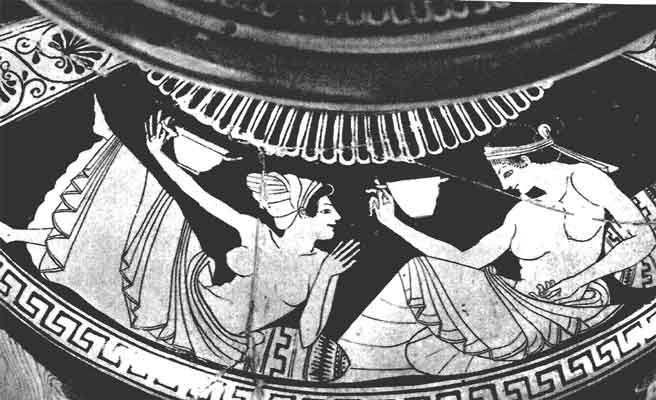
All of which was a romanticization of Greek and Roman societies, which were just as hierarchical and restrictive in setting up their own separate spheres between the sexes, where only free men had access to the public sphere, free discourse, and the option to explore homosexuality or bisexuality. Indeed male/male relationships (homosocial as opposed to homosexual relationships) were considered the ideal; if men were to seek out the female society of gynaekes (wives), this was simply for procreative or domestic relationships, and if a man wanted sexual pleasure or intellectual companionship from a woman, then there were the hetaera (educated courtesans), and on a lower rung pallakide (mistresses), and, below that pόrne (prostitutes). For example, as noted by Demosthenes:“We have hetaerae for pleasure, pallakae to care for our daily body’s needs and gynaekes to bear us legitimate children and to be faithful guardians of our households” (Wikipedia) (yes, sometimes I use Wikipedia for quick reference, but if you’re interested in reading something more scholarly, one of my former teachers at Hunter College, Sarah B. Pomeroy, has a great book on this topic, Goddesses, Whores, Wives, and Slaves: Women in Classical Antiquity ). Ironically, then, this romanticized return to so-called paganism and/or the classical world was in fact quite reassuring of Victorian social structures and assigned sexual roles for women and men. Nevertheless, if one were to focus solely on the Greek gods and goddesses then certainly these provided an outlet for more passionate and liberal sexualities, and so of course they might appear attractive to an author attempting to explore “other” sexualities or identities.
Picture
Hetaera, Phintias Painter, c. 510 BC
Thus, Swinburne and “Michael Field” (a pseudonym for the poets and playwrights, Katherine Bradley and her niece, Emma Cooper) are pressured to disguise same-sex desires through coded language and mythologies, especially if we consider that homosexuality was illegal and one could be imprisoned for it or publicly censured—for example, the infamous Oscar Wilde trials  and the scandal surrounding Radclyffe Hall’s The Well of Loneliness  (a 1928 novel depicting a lesbian relationship). Fortunately, we see during the modernist period authors increasingly taking the risk to write about same-sex desire even if they remained “closeted,” for instance Virginian Woolf and E. M. Forster, whose work we’ll be reading next week. By taking these risks, such writers contributed through literature to the increasing socio-cultural acceptance of non-hetero romantic love and sexual identification, or, if not entirely accepted, at least the gains in freedom of speech to write or speak of same-sex desires and relationships without having to disguise it to the point of near-invisibility.
 
So, considering Victorian contexts, even if during the fin-de-siècle period where there was a (slight) loosening of gender roles/relationships, it’s no surprise that Swinburne’s poetry is densely symbolic, much of which is used to “veil” sentiments or desires not condoned by Victorian norms and legalities. Likewise, Cooper and Bradley employ a male pseudonym to veil the authors’ relationship, which was not only transgressive as a lesbian partnership but one that was also incestuous (indicated in the authors’ bios). Borrowing from Sapphic tradition, as grounded in Sappho’s fragmented texts (because fragments are all that survived antiquity) and the corresponding myths constructed around a woman poet about whom very little is known, this also provides “Field” with some authority for establishing a separate sphere comprised wholly of female desire, companionship, and love. In this sense, yes, Cooper and Bradley reinforce the ideology of separate spheres but in a way that subverts and redefines it. 
                
Picture
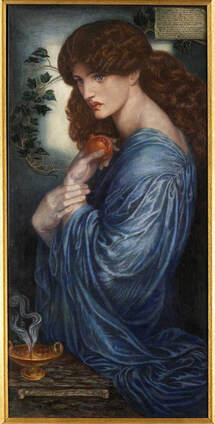
In “Hemaphroditus,” Swinburne also attempts to redefine, and more obviously reject, the separation between the sexes, showing where the two blend, yet this blending is also remarked upon as “sterile”—thus hinting at a common view of same-sex desire in contrast to reproductive sexuality. In “Hymn to Proserpine,” the male speaker wholly identifies with a female goddess and by extension a feminine-maternal realm. Whether accurate or not, this is something often observed of gay men or gay culture when homosexuality is read as a general rejection of a patriarchal system, since to identify with “the feminine” can be incredibly subversive in a world where “the masculine” is set up as the norm: to identify with the masculine is to gain access to power and inherent value, based on the oppression/suppression of the feminine; to reject the masculine is to reject phallic power and privilege over female bodies. Lesbian desire is also subversive in a similar way in its rejection of the patriarchal “law” that dictates and relies upon female bodies as objects of male desire, or, as objects of exchange or currency between men.

Dante Gabriel Rossetti, Proserpine, 1874 ​

Of course, I recognize that we have to dig deep to get at some these buried impulses or desires, and socio-political critiques of patriarchy, as represented in the texts (especially Swinburne’s texts), but if we take the time to make these kinds of textual excavations then our understanding of such texts and the cultures/societies that produce them are in many ways expanded and enriched. As for the rest of the week’s assigned reading, although these are a bit lengthy (one a comedy of manners and the other a gothic novella), they should be a little “easier” to grapple with, though the depictions of late Victorian masculinities and homosocial relationships in The Importance of Being Earnest and Jekyll and Hyde will offer deeper insights into the earlier texts from this week as well as helpful transitions to themes explored over the next few weeks in our readings of modernist and contemporary texts.
1 Comment

"The Woman Question"

5/11/2020

1 Comment

 
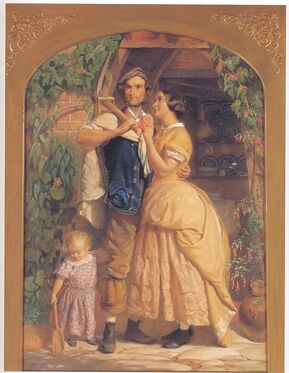
Image: The Sinews of Old England (1857) by George Elgar Hicks shows a couple "on the threshold" between female and male spheres (Wikipedia)
Picture
The readings from this first week explore the complexity of Victorian views when attempting to answer the "Woman Question." As we see from John Stuart Mill and Florence Nightingale, both men and women during this time refused the status quo by challenging the perceived "natural" division between the sexes. And, as John Ruskin, Coventry Patmore, and Sarah Stickney Ellis reveal, both men and women were responsible for reinforcing the gender norms of the time through their insistence that women "naturally" belonged in the private sphere. The selections of poems by Alfred, Lord Tennyson's and Elizabeth Gaskell's short story provide somewhat opposing gendered views, yet, you should also pay attention to the internal tensions and contradictions in each of their works for what they reveal about the complexities of 19th Century gender roles, as well as views concerning female sexuality, which weren't really touched upon in the essays.

​Although we often have a popular perception of the Victorians as ridiculously repressed and conservative, they were often intensely preoccupied with defining and containing female sexuality by reinforcing gendered binaries that intersected with class divisions. These binaries severely limited women's identities to two opposing archetypes: either the "Angel in the Home" (private sphere) or the "Fallen Woman" (public sphere). In other words, the construction of separate spheres did not just apply to perceived differences between men and women, but also differences between women. On the one hand, you had the desexualized and morally pure Wife/Maiden and on the other, the sexually threatening  and morally corrupt Prostitute. Thus, the theory of separate spheres provided very little space for real women to maneuver between these two extremes.

Also, it should be noted, by placing women on such high pedestals (as "Angels"), thus obligating them to be no less than perfect, this essentially keeps women subjugated to an impossible ideal while erasing or silencing their realities, their persons, and their multifaceted desires and capabilities (and flaws). J. S. Mill's argument is perhaps one of the most balanced and perceptive in its observation that despite all that was written about women, very little was actually known or understood about women because women were rarely given the opportunity to speak or write about their lives and experiences. Indeed, Mill's argument, following Mary Wollstonecraft's A Vindication of the Rights of Women (1792), was influential on 20th C. writers and feminist philosophers. For instance, as French feminist Hélène Cixous claimed in her essay, "The Laugh of the Medusa" (1975): "Woman must write herself. ... [She] must put herself into the text—as into the world and into history—by her own movement."
​
So, as we proceed through the 19th and 20th centuries, we shall see how women increasingly began doing this, and how some often resisted a "women's movement" while others, including men, increasingly began to question (and subvert) social constructions of gender. Lastly, it's important to keep in mind that the Victorian era was one that saw a series of social reform acts, including incremental changes in child custody, divorce, and marital law, all of which helped pave the way for the suffrage and feminist movements of the 20th Century.

1 Comment

Tennyson's "Angels"

5/11/2020

0 Comments

 
So, my discussion of Tennyson here is mostly based on my personal (rather than scholarly) reading of the poems I’ve selected from his extensive body of work. I’m generally not a fan of Tennyson, but I’ve always enjoyed these specific poems and they work really well in the context of the other readings from the first unit. Placing “The woman’s cause is man’s” alongside “Mariana” and “Now Sleeps the Crimson Petal” (as well as “Tears, Idle Tears”) allows for a more complex understanding of Tennyson and his representation of women’s “proper” roles in tandem with Victorian views concerning female sexuality and the burgeoning suffrage movement. Moving from “Mariana” to “Crimson Petal” to “The woman’s cause” seems to follow an increasingly complicated and ambiguous trajectory with regards to the poet’s own developing opinions concerning male-female relationships; yet, all three poems seem to articulate the same thing: a woman’s identity, value, place, and desire can only be defined in her relation to men. This, of course, was a predominant Victorian view, but I think we do see Tennyson trying to work through this and come up with something more progressive, at least considering the time in which he wrote
Picture
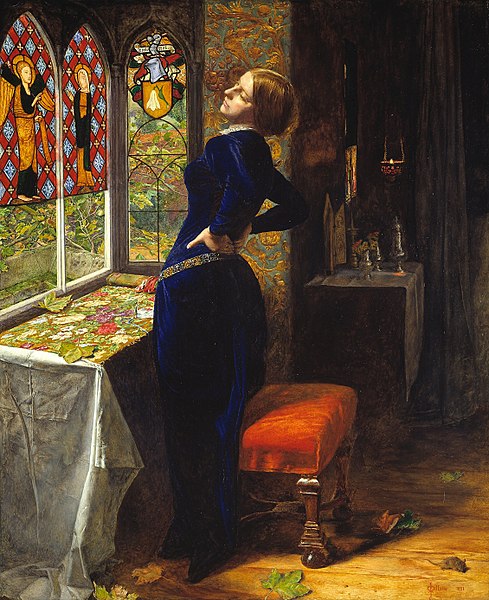
                John Everett Millais, Mariana (1851)
​In “Mariana,” the woman is an empty shell without the man who has abandoned her, her life left without meaning, and with no hope of regeneration or rebirth. Whether she was abandoned by her husband or lover is incidental, since at this time, an abandoned woman was a “fallen” or lost woman. According to the Victorian rationale (which often continues to influence contemporary views of women, especially in cases of sexual assault), surely it was something she did and not the fault of the man—or, to be an abandoned woman was to be an incredibly vulnerable woman, prey to the “naturally” baser or corrupt qualities of men. 
Picture
Strangely, according to this logic, a woman without the protection of a man also gained a kind of “freedom” to fall—either into despair/melancholy, like Mariana, or an unseemly voluptuousness of desire without anything to keep that desire or her emotions in check. The poem is definitely concerned with female desire, but a kind of “rotten” or decaying desire, as indicated by the poem’s imagery. Her expression of deep despair is overwhelming and potentially threatening to the stability of society since her lover will not return (“He cometh not”) to circumscribe her within his own desire. Even if Mariana is confined within her proper sphere—the home—that space is abandoned and corrupt with excessive longing and grief without the male’s presence to counterbalance this; without him, her only desire is to die. Though, in spite of this, perhaps Tennyson was trying to advocate for the vulnerability of such women?? Merely a suggestion….
 
In any case, this reading of “Mariana” allows for a contrasting yet complementary reading of the other two poems. I would argue that the speakers of “Crimson Petal” and “The woman’s cause” are unquestionably male; however, the attempt to read either speaker as female, as some of my students have done in the past, certainly allows for some interesting interpretations. The woman in “Crimson Petal” is enveloped by the male to the point of being entirely subsumed (a desirable result for the speaker). However, there's this tricky imagery of the female penetrating the male, which seems to reverse what we might expect (in a heterosexual framework, at least). In some ways, though, this inter-penetrative imagery falls in line with the impetus of “The woman’s cause” in its argument that male and female must complement each other.
 
“The woman’s cause,” as placed within the larger poem sequence of The Princess, does not provide so much an argument for women’s equal rights as it does a reminder to women of their proscribed social, domestic, and intellectual limitations. Princess Ida has attempted to create a female utopia in which women might pursue their education without the interruption (and interfering distraction) of men. Tennyson appears quite prescient in outlining what would become one of the major demands of the women’s movements of the 19th and 20th centuries (though Wollstonecraft had already identified these in the 18th C.): a woman’s right to an education as the only avenue toward true equality. Yet, by the end of The Princess
, and specifically in “The woman’s cause,” Ida is firmly put in her place, shown to be a somewhat “monstrous” woman for demanding an education—at least an education not determined by her father or husband. The prince has clearly “corrected” and educated her as to the complementary rather than separate identity that she should fashion in relation to her prospective husband. Ida is safely and soundly contained by the end of the poem via the prince’s lecture; she is enlightened as to the errors of her ways and the poem confirms (albeit unintentionally) women’s necessary complicity with the very system and ideology that oppresses them.

Overall, then, Tennyson seems to progress in his thinking but actually in all three poems he adheres to the predominant views of his day: that men and women have inherent traits that determine their places in relation to each other, an essentialist view that positions women in a desirably submissive role, and without room or space to define herself apart from male desires (or voices) interjecting. Indeed, these poems taken as a whole articulate the qualities that Victorian males might desire in their female counterparts but not necessarily what women might desire for themselves. And in that sense, the poems are very much about male domination—even if expressed as “benevolent domination” (an oxymoron if there ever was one)—at the expense of genuine gender equality, and female desire is if anything a “glimmering ghost.”

That said, I would point out a couple things in Tennyson’s defense, or, at least a couple things that might further complicate our understanding of his work. First, in his willingness to grant women some expression of desire or sexuality, he emphasizes the dangers of repressing sexuality as equivalent to suppressing full human expression, and for that matter, full understanding of sexual relations between men and women. The erotic energy of “Crimson Petal,” even if positioning women in a submissive role, still allows women some kind of role whereas many Victorian texts entirely negate the presence of sexuality or the act of sex. For example, in many Victorian short stories/novels, such as Gaskell’s “The Nurse’s Story,” women suddenly seem to produce babies without any warning or indication that they’ve had the prerequisite sex to make that biological phenomenon possible (another apt example is Cathy in Wuthering Heights). So, let’s at least give Tennyson some credit in his attempts to make visible that women do have desires, even if those desires are not exactly on par with our contemporary notions of “liberated” sexuality. Although there is something about these poems that is incredibly seductive in their appeal to romantic fantasies, we should not forget that those sentiments expressed toward the desire of finding one’s romantic or domestic “soul mate” are nevertheless constructed on unequal terms.
 
Lastly, and just as an aside, we might also explore a different, possibly “queer” reading of these poems. Many critics have interpreted Tennyson’s identification with abandoned, desperately yearning women as an expression of his own “feminine” desires. Much of his work can be read as testaments to his lifelong mourning for the loss of his closest friend, Arthur Hallam, who died quite young. Subsequently, through this interpretive approach, Tennyson’s own homoerotic desires are given voice through female characters such as Mariana or the speakers of “Tears, Idle Tears” and the “Crimson Petal.”
 
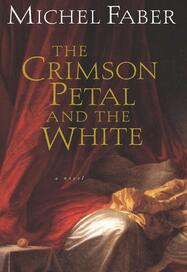
For anyone interested, The Crimson Petal and the White by Michel Faber is a rich “neo-Victorian” novel that takes Tennyson’s poem as inspiration for a complex tale that examines from a contemporary perspective the dichotomy of the “Angel in the Home” (white petal) and the “Fallen Woman” (crimson petal), while brilliantly disrupting our notions of these along the way. Definitely a great novel, but like many Victorian novels, a monstrously long read. There’s also a very good and “faithful” four-episode adaptation of the book made for the BBC (and now available streaming) in case anyone wants to supplement their understanding of the many themes and issues we are discussing in this class; though of course I highly recommend you read the book at some point, even if you watch the film version prior to this. 
​

0 Comments
<<Previous
Forward>>

    Hope Jennings

    Dedicated blog and discussion page for
    ENG 3230: British Texts,
    ​Mid-19th to 21st Century

    Picture

    Archives

    June 2020
    May 2020

    Categories

    All

    RSS Feed

Powered by Create your own unique website with customizable templates.